


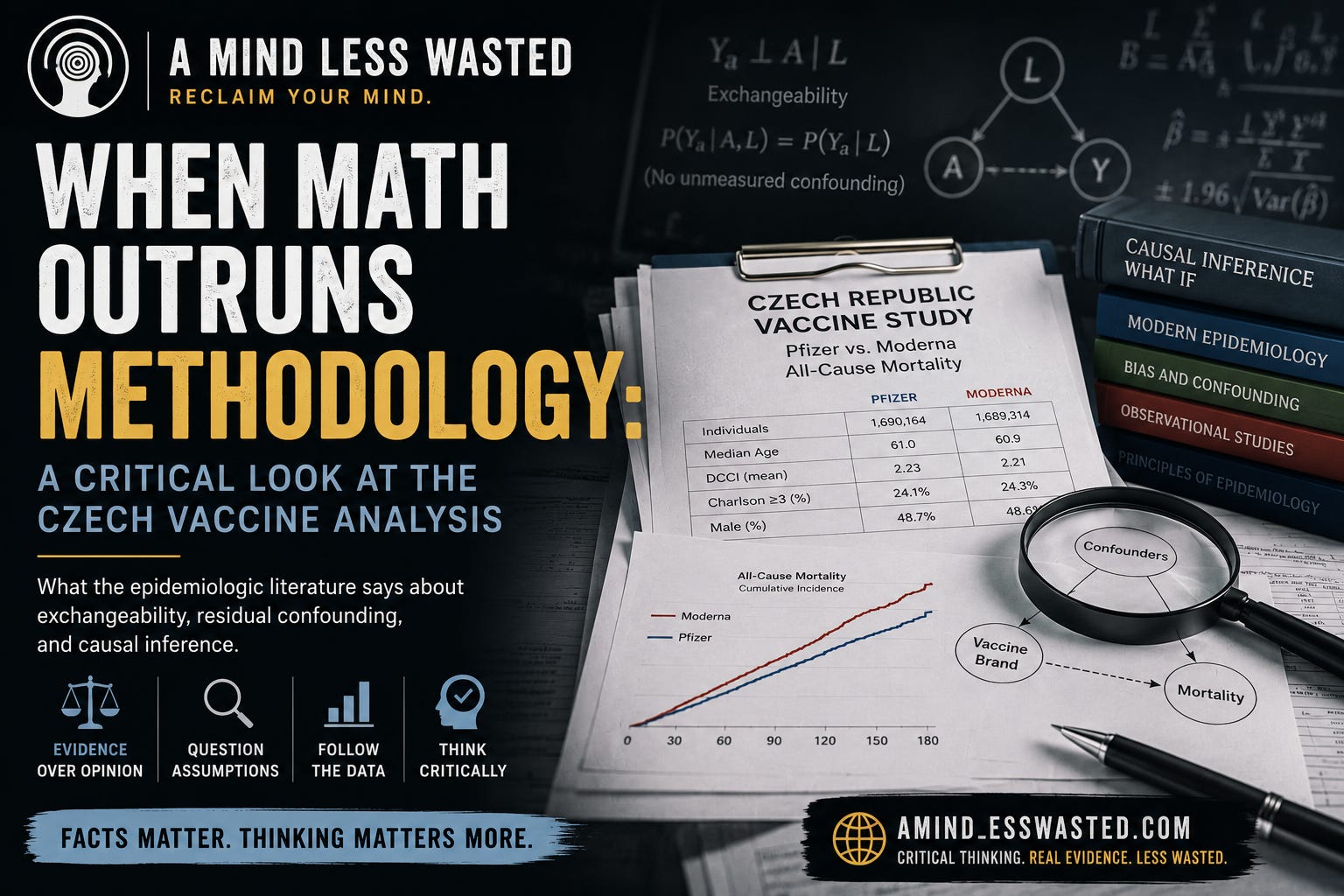
Update, August 2026: This article originally examined Steve Kirsch’s Pfizer-versus-Moderna analysis of Czech mortality data. It has now been expanded to address his KCOR method and its claimed correction for healthy vaccinee and frailty effects.
Introduction
One of the easiest ways to make an argument look convincing is to place enough Greek letters and regression models between the reader and the conclusion. When the math looks complicated, most of us assume someone with the right expertise has already checked the assumptions.
That’s understandable. It’s also why observational studies can be so persuasive and so easily misinterpreted.
A statistical model can be mathematically sound while the conclusion drawn from it remains scientifically unsupported. Every model depends on assumptions. If those assumptions are incomplete or unjustified, sophisticated mathematics cannot turn an observational association into proof of causation.
That distinction is central to Steve Kirsch’s recent analysis of Czech mortality data comparing recipients of the Pfizer and Moderna COVID-19 vaccines.
Kirsch reports using exact-week standardization and matching within DCCI categories to reduce measured differences between the two vaccine groups. He also acknowledges that unmeasured differences in how the vaccines were allocated have not been sufficiently excluded to establish causation. Yet he ultimately argues that baseline differences between the groups can reasonably be ruled out, leaving vaccine brand as the most plausible explanation.
This article examines whether the evidence supports that stronger causal conclusion.
This article is not an attempt to prove Steve Kirsch wrong. Nor is it an attempt to defend or criticize COVID-19 vaccines. It asks a narrower question, but a far more important one:
Does the Czech analysis satisfy the methodological standards that epidemiologists require before concluding that an observed association is causal?
The Czech dataset deserves serious attention. It contains individual records from millions of people, exactly the kind of real-world data researchers should examine when evaluating vaccine safety. If recipients of one vaccine appear to have higher all-cause mortality than recipients of another, that finding should be investigated carefully.
But finding an association is only the first step. Showing that one vaccine caused the difference is much harder.
The calculations themselves are not the issue. The real question is whether the assumptions behind them are strong enough to support a causal conclusion.
Statistics can measure an association with remarkable precision. They cannot tell us, on their own, what caused it.
That is one of the central challenges of observational research. Even sophisticated adjustments cannot remove every source of bias. Residual confounding, healthy vaccinee bias, frailty bias, treatment selection, and other systematic differences between groups can produce convincing mortality patterns when the vaccine itself is not responsible.
Kirsch has identified an association in the Czech data. Whether it represents a true effect of vaccine brand is a separate question, and complicated mathematics alone cannot answer it.
The rest of this article examines the assumptions behind that interpretation and compares them with the standards used in modern causal inference.
The Assumptions Behind the Analysis
Every statistical analysis starts with assumptions. Some are stated openly. Others are built into the model or the way the results are interpreted. If those assumptions are wrong, the calculations can still be accurate while the conclusion is not.
Kirsch’s analysis is no exception.
His claim that the mortality difference between Moderna and Pfizer recipients was caused by the vaccines, rather than by systematic differences between the groups, depends on several assumptions. He discusses some of them directly. Others become apparent from the conclusions he draws.
The question is not whether those assumptions sound reasonable. It is whether the evidence supports them.
That is the challenge with observational data. It can reveal an association very clearly, but concluding that one factor caused another requires confidence that the comparison was fair and that other likely explanations have been adequately ruled out.
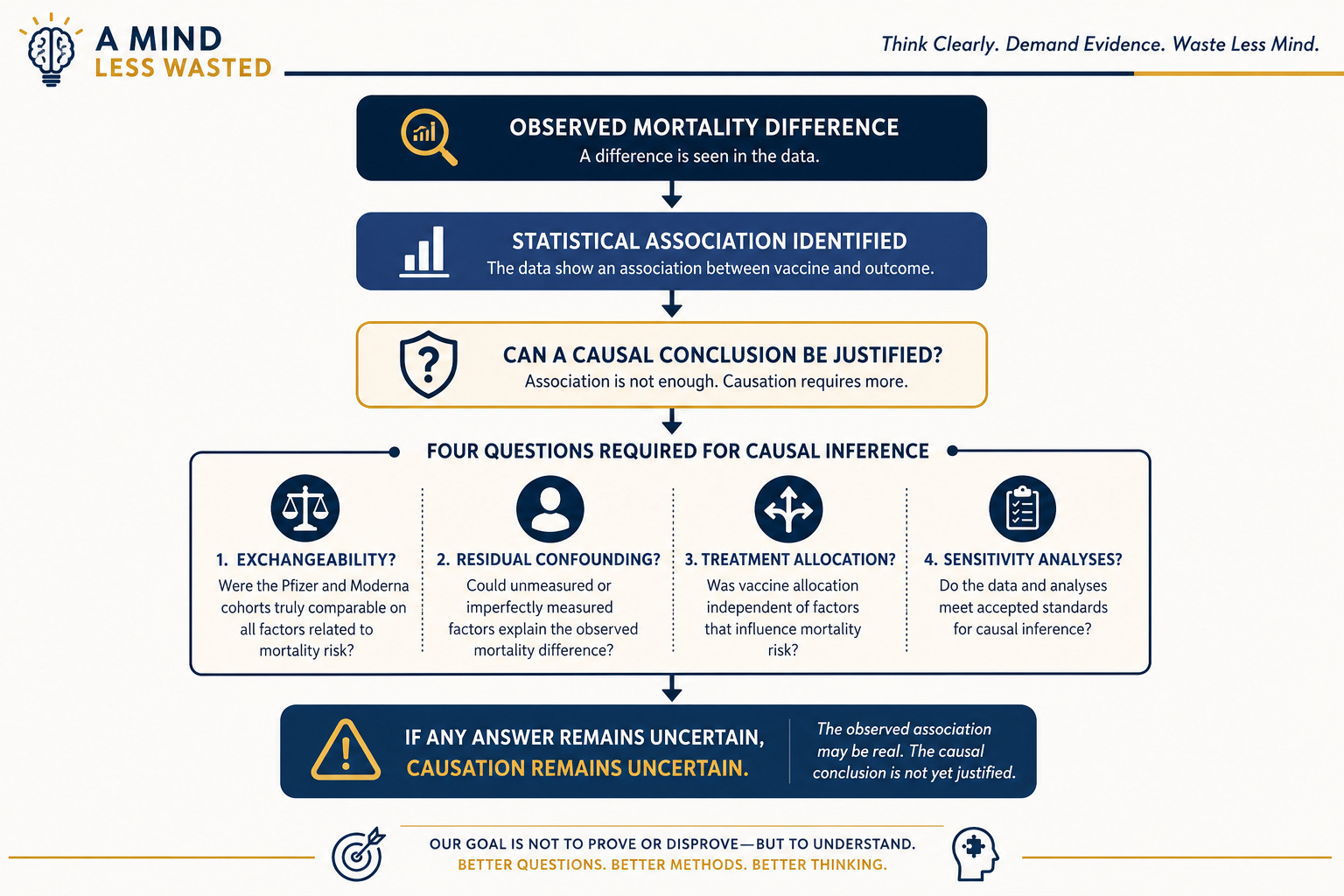
To evaluate the Czech analysis, we’ll examine four questions that epidemiologists routinely ask when assessing observational research:
Were the Pfizer and Moderna cohorts truly comparable?
Could residual confounding explain the observed mortality difference?
Was vaccine allocation independent of factors that influence mortality risk?
Do the data satisfy the methodological standards required to infer causation?
If the answer to any one of these questions is “not yet,” then the observed association may warrant further investigation, but the causal conclusion remains uncertain.
Rather than asking readers to accept or reject Steve Kirsch’s conclusions, we’ll compare each of these assumptions against established principles of epidemiology and causal inference. The goal is not to determine whether one vaccine is safer than another, but to determine whether the evidence presented is sufficient to support the causal claims being made.
1. Were the Pfizer and Moderna Cohorts Truly Comparable?
A key part of Steve Kirsch’s argument is that Pfizer and Moderna recipients had very similar Deyo–Charlson Comorbidity Index (DCCI) scores. He takes that similarity as evidence that the groups were comparable before vaccination, making differences in their underlying health an unlikely explanation for the mortality gap.
That may sound reasonable, but it asks the DCCI to do something it was not designed to do.
The Charlson Comorbidity Index is a tool for estimating a patient’s risk of death based on documented medical conditions. It assigns different weights to specific diseases and combines them into a single score. In general, a higher score indicates a greater risk of death.
That makes the DCCI useful for estimating prognosis. It does not make it a test of whether two groups are comparable enough to support a causal conclusion.
For that, epidemiologists look for what is known as exchangeability. In simple terms, the groups must be similar enough that either could reasonably stand in for the other, as if the vaccine they received had been assigned at random. Only then can a difference in outcomes be attributed to the vaccine rather than to other differences between the groups.
Similar Charlson scores do not establish that. Kirsch’s argument depends on treating those scores as evidence that most meaningful differences between the groups have been eliminated. The DCCI alone cannot support that conclusion.
Why?
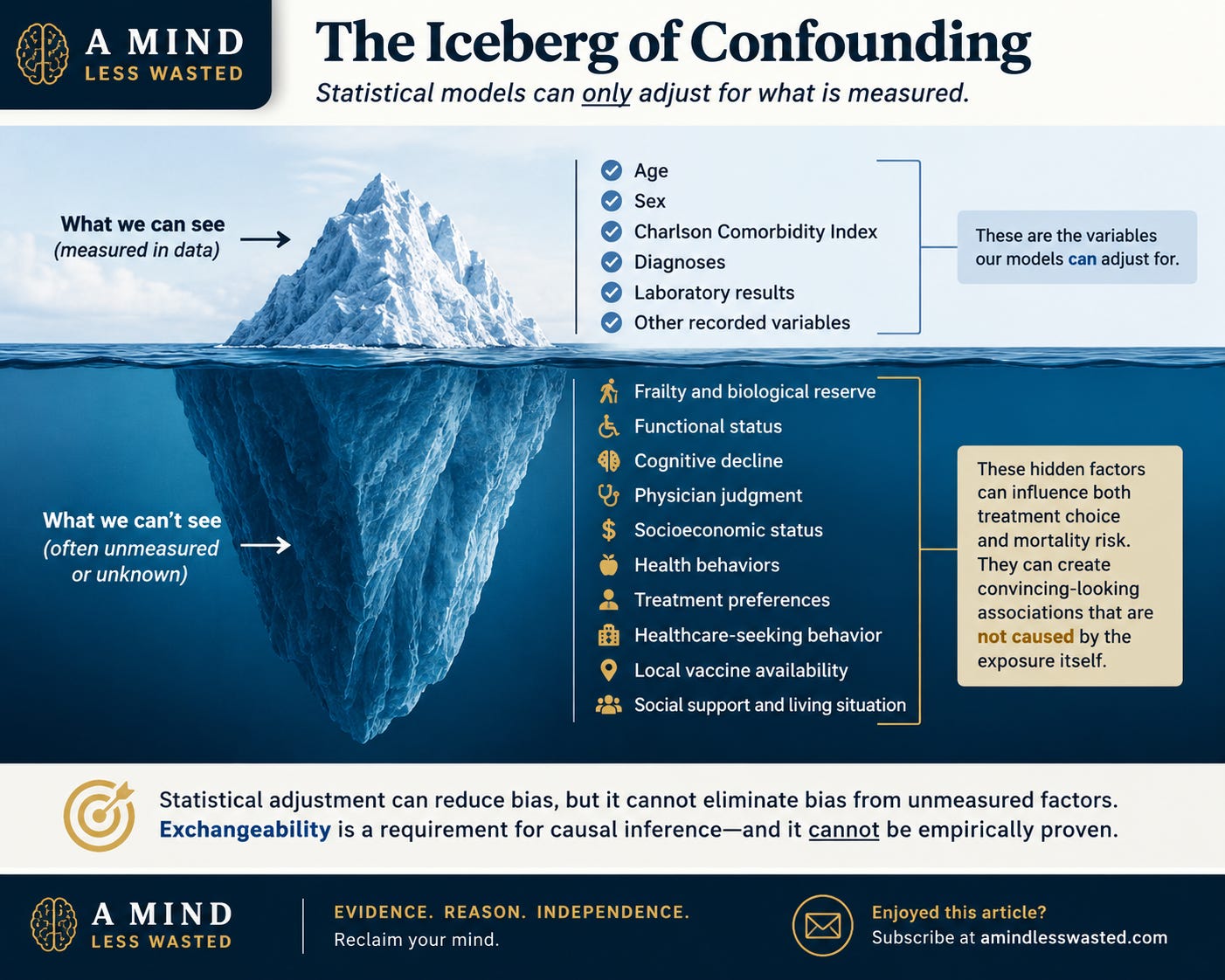
Because the Charlson Index captures only a limited subset of factors that influence mortality. It does not adequately capture frailty, functional status, the severity of cognitive impairment, nursing home residency, socioeconomic status, healthcare-seeking behavior, physician prescribing preferences, or numerous other characteristics that may influence both vaccine selection and mortality risk.
Two patients can have identical Charlson scores while differing substantially in their overall health and life expectancy.
One might be an active 75-year-old living independently. Another might be a frail 75-year-old requiring assistance with daily activities. Both could receive the same Charlson score while having very different baseline risks of mortality.
Unfortunately, epidemiology doesn't award bonus points for beautifully balanced spreadsheets. This is precisely why epidemiologists distinguish balance on measured variables from exchangeability.
As epidemiologist Miguel Hernán has emphasized, exchangeability is an identifying assumption; it cannot be demonstrated simply by showing that measured characteristics appear similar.
As he has written, “Exchangeability cannot be empirically tested in observational studies.” That principle is central to causal inference. Even perfect balance on measured variables cannot prove that two observational groups were otherwise comparable or rule out important unmeasured confounding.
In other words, similar DCCI distributions indicate that the Pfizer and Moderna cohorts are balanced with respect to one composite prognostic measure.
They do not demonstrate that the Pfizer and Moderna recipients were otherwise comparable in every respect that matters for causal inference.
That distinction is critical because Kirsch’s argument depends on the premise that comparable Charlson scores largely eliminate baseline differences as an explanation for the mortality gap.
The epidemiologic literature does not support that conclusion.
Instead, it supports a more cautious interpretation: similar Charlson scores are reassuring, but they are only one piece of a much larger puzzle. They cannot, by themselves, establish the exchangeability required to infer that vaccine brand caused the observed difference in mortality.
Takeaway: Similar Charlson Comorbidity Index distributions demonstrate balance on one composite prognostic measure. They do not establish exchangeability or eliminate the possibility of residual confounding. For that reason alone, they cannot support a causal conclusion.
☕ Coffee Break
Here’s the entire argument so far, in plain English:
Similar Charlson score distributions tell us the groups looked similar on one summary measure of recorded illness. They do not tell us the groups were otherwise comparable.
That’s why epidemiologists spend so much time worrying about confounding instead of celebrating balanced spreadsheets.
Now let’s look at the next question: Could hidden differences between the groups still explain the mortality gap?
Enjoying the article so far? This would be a great time to share it with someone who might appreciate it.
2. Could Residual Confounding Explain the Mortality Difference?
Having concluded that similar Charlson Comorbidity Index (DCCI) scores do not establish exchangeability, the next question naturally follows:
Could unmeasured differences between the Pfizer and Moderna cohorts still explain the observed mortality difference?
Steve Kirsch contends that this is unlikely. His analysis suggests that the two groups were sufficiently similar at baseline that residual confounding cannot reasonably account for the results.
The epidemiologic literature, however, urges considerably more caution.
Residual confounding refers to differences between study groups that remain after statistical adjustment. These differences may arise because important variables were never measured, were measured imperfectly, or were included in the model in ways that do not fully capture their influence on the outcome.
This is not a minor technical concern. It is one of the central challenges of observational epidemiology.
Statistical adjustment can account only for the information available to the researcher. It cannot adjust for factors that were never recorded.
For example, administrative health databases often include diagnoses, procedures, prescription records, and demographic information. However, they rarely capture many of the factors physicians routinely consider when making clinical decisions, such as frailty, functional status, cognitive impairment, subtle acute illness, social support, or a clinician's judgment that a patient is "too sick" or "too well" for a particular intervention.
These factors may influence both which vaccine a person receives and their subsequent risk of death.
If they are not adequately measured, they cannot be fully adjusted for.
This phenomenon has been observed repeatedly in vaccine research and is commonly described as healthy vaccinee bias or frailty bias.
Healthy vaccinee bias occurs when individuals who receive a particular intervention are, on average, healthier than those who do not. Frailty bias reflects the opposite phenomenon: individuals who are older, frailer, or approaching the end of life are often less likely to receive certain medical interventions or may receive them later. Because these characteristics are difficult to measure completely, they can produce misleading differences in mortality that are unrelated to the intervention itself.
Some of the clearest evidence for the importance of residual confounding comes from studies that produced biologically implausible findings.
For example, observational vaccine studies have sometimes reported protective associations before or outside periods when the vaccine could plausibly have affected the outcome. Investigators have interpreted such patterns as evidence of healthy vaccinee bias or residual confounding rather than as proof of a broad protective effect.
That interpretation is significant because it illustrates an important principle of observational epidemiology.
It demonstrates that even carefully designed observational studies using large datasets and sophisticated statistical models can produce substantial differences in all-cause mortality that are attributable, at least in part, to systematic bias rather than to the exposure being studied.
This does not prove that residual confounding explains the mortality difference observed in the Czech data.
But it does demonstrate something equally important.
The epidemiologic literature does not support the conclusion that residual confounding can be dismissed simply because measured variables appear balanced or because extensive statistical adjustments have been performed.
Residual confounding remains a plausible alternative explanation unless additional analyses substantially reduce that concern.
For that reason, the burden of proof does not rest on showing that confounding definitely explains the Czech findings. Rather, it rests on demonstrating that confounding has been reduced sufficiently to make a causal interpretation the most reasonable explanation.
The current analysis does not establish that standard.
Takeaway: Published epidemiologic studies consistently show that residual confounding can produce substantial differences in all-cause mortality, even after extensive statistical adjustment. Similar measured characteristics and sophisticated models reduce uncertainty, but they do not eliminate it. As a result, residual confounding remains a credible alternative explanation for the mortality differences observed in the Czech analysis.
3. Was Vaccine Allocation Independent of Mortality Risk?
Even if two groups appear similar on measured characteristics, another critical question remains:
How were individuals assigned to each vaccine?
Steve Kirsch argues that systematic differences in vaccine allocation are unlikely to explain the mortality gap. If true, that would strengthen the case that the observed association reflects a genuine difference between the vaccines.
The difficulty is that observational studies rarely have the luxury of random assignment.
Unlike a randomized clinical trial, vaccine allocation during a public health campaign is influenced by numerous factors that may never appear in administrative databases. These include vaccine availability, regional distribution, institutional purchasing decisions, physician recommendations, patient preference, local public health policy, and the timing of vaccine rollouts. Clinical judgment also plays an important role. Physicians routinely consider factors that are difficult or impossible to capture in large datasets, such as frailty, functional status, acute illness, or whether a patient appears too unstable to receive a particular intervention.
These decisions are often based on information that never appears in administrative databases, making them impossible to adjust for completely.
Calendar time may also influence treatment allocation. Vaccine availability, circulating variants, prior infection rates, public health recommendations, and eligibility criteria often changed throughout the vaccination campaign. If these factors differed between recipients of the two vaccines, they could introduce additional confounding unless adequately accounted for in the analysis.
None of these factors necessarily introduce bias, but each has the potential to do so.
The challenge is that many of these influences are either incompletely measured or not measured at all. If they affect both vaccine selection and mortality risk, they become sources of confounding that statistical adjustment cannot fully eliminate.
This point is well recognized in modern epidemiology. Researchers generally do not assume that treatment allocation in observational studies is effectively random unless there is compelling evidence to support that conclusion.
Another important assumption is positivity, the idea that comparable individuals had a realistic opportunity to receive either vaccine. If certain groups overwhelmingly received one vaccine because of supply constraints, regional policies, institutional practices, or rollout timing, estimating a causal comparison between vaccine brands becomes substantially more difficult.
That does not mean vaccine allocation in the Czech Republic was biased. It means the available evidence has not demonstrated that it was free from bias.
This distinction is important because the burden of proof changes depending on the conclusion being drawn. Demonstrating a statistical association requires only that the association exists. Demonstrating causation requires confidence that alternative explanations, particularly systematic differences in how individuals entered each group, have been adequately addressed.
The Czech analysis provides evidence of the first.
Whether it establishes the second remains uncertain.
Takeaway: Unless factors influencing both vaccine allocation and mortality are adequately measured and addressed, systematic differences between the Pfizer and Moderna cohorts remain a plausible alternative explanation for the observed mortality gap.
4. Does the Evidence Support a Causal Conclusion?
By this point, the central issue should be clear.
The question is no longer whether Steve Kirsch identified a statistical association.
The Czech data appear to show one.
The question is whether the evidence presented justifies concluding that the vaccines themselves caused the observed difference in mortality.
Modern epidemiology draws a careful distinction between identifying an association and establishing causation. This distinction exists because observational research is inherently vulnerable to confounding, selection bias, and other systematic errors that cannot always be eliminated through statistical adjustment.
For that reason, causal inference relies on more than regression models and adjusted hazard ratios.
Researchers ask additional questions.
Can the findings be reproduced using different study designs?
Do negative-control analyses suggest residual bias?
Would a target trial emulation produce the same result?
How sensitive are the conclusions to plausible levels of unmeasured confounding?
Do alternative analytical approaches lead to similar estimates?
Epidemiologists often use sensitivity analyses to estimate how strongly an unmeasured factor would need to influence both vaccine selection and mortality to explain an observed association. These methods cannot eliminate uncertainty, but they can show whether a result remains credible under plausible levels of hidden bias. Without such analyses, it is more difficult to determine whether residual confounding could reasonably account for the reported mortality difference.
These questions are not academic exercises. They are safeguards against mistaking correlation for causation.
This is precisely why epidemiologists often reach more cautious conclusions than commentators examining the same dataset. The goal is to ensure that the evidence justifies the conclusions being drawn.
None of this means the Czech findings should be dismissed.
On the contrary, they deserve scrutiny and, if warranted, independent replication using multiple analytical approaches designed specifically to address residual confounding and treatment-selection bias.
Observational studies can support causal inference, but only when the causal question, study design, identifying assumptions, and analytical methods are sufficiently strong. Unexpected associations should prompt additional investigation, sensitivity analyses, stronger study designs, and attempts to reproduce the findings under different assumptions. They should not be treated as causal merely because the adjusted estimate is precise.
Scientific progress depends on investigating unexpected findings rather than ignoring them.
At the same time, unexpected findings should not be treated as established causal relationships before the methodological assumptions required for causal inference have been adequately justified and the findings tested against plausible alternative explanations.
The distinction may seem subtle.
It is not.
It is one of the defining principles of modern epidemiology.
Update: Does KCOR Solve the Healthy Vaccinee Problem?
Steve Kirsch has since argued that his KCOR method answers the central methodological objection raised in this article. KCOR attempts to correct for differences in latent frailty between vaccinated and unvaccinated cohorts by modeling mortality through a Gompertz baseline combined with a gamma-frailty distribution. Kirsch contends that this adjustment neutralizes the healthy vaccinee effect and reveals an increased risk of death following vaccination.
The method deserves examination. But it does not convert the Czech data into a causal experiment.
What KCOR Actually Does
KCOR analyzes the shape and curvature of cumulative mortality trajectories. It estimates how much of the difference between cohorts may be attributable to the progressive depletion of frailer individuals from each group. It then mathematically reconstructs what Kirsch calls a “depletion-neutralized” cumulative hazard.
That may be a useful descriptive exercise. It is not the same as estimating what would have happened to the same individuals had they made a different vaccination choice.
This distinction is not merely a criticism imposed by outsiders. The KCOR manuscript itself describes the method as a “diagnostic and descriptive framework” that targets cumulative contrasts rather than counterfactual effects. It also states that KCOR “does not assert a causal interpretation” and does not become a causal-effect estimator simply because the model produces stable results.
That creates a significant gap between the paper and the public claim.
The paper presents a model-dependent, depletion-adjusted comparison. Kirsch publicly interprets that comparison as evidence that the vaccines increased the risk of death. The second claim is stronger than the first.
Mathematical Inversion Does Not Eliminate Causal Assumptions
KCOR depends on several important assumptions:
latent frailty is adequately represented by a gamma distribution,
the underlying mortality hazard is adequately represented by a Gompertz model,
the selected “quiet windows” accurately capture baseline mortality behavior,
mortality curvature primarily reflects depletion of frail individuals,
external hazards affect the cohorts in sufficiently comparable ways,
and relevant differences between vaccinated and unvaccinated people can be inferred from aggregate mortality trajectories.
These are not minor implementation details. They determine what the model assigns to frailty, what it removes through normalization, and what remains afterward.
Kirsch’s paper explicitly acknowledges that the inversion is exact only under the assumed gamma-frailty model. It also states that if either the frailty model or baseline specification is materially wrong, the procedure may introduce bias rather than remove it.
That is the key issue.
A model can fit the observed curves and still misidentify why those curves have their particular shape. Mortality curvature could reflect frailty depletion, but it could also reflect changing infection rates, seasonality, prior infection, treatment availability, healthcare disruption, behavioral differences, institutional outbreaks, socioeconomic factors, or several mechanisms operating simultaneously.
KCOR cannot uniquely determine which of those mechanisms generated the observed pattern. The manuscript acknowledges that the same curvature may arise from selection, behavior, seasonality, treatment effects, reporting artifacts, or combinations of these factors.
The model therefore does not remove the need to establish exchangeability. It substitutes a specific mathematical representation of unmeasured differences for direct evidence that the cohorts were causally comparable.
What Do the Synthetic Negative Controls Prove?
Kirsch emphasizes that KCOR performs correctly on synthetic negative controls. In those simulations, cohorts are deliberately assigned different frailty structures while the true treatment effect is set to zero. KCOR then recovers a result near the expected null.
That demonstrates that the method can behave correctly when data are generated according to assumptions closely matching the model.
It does not demonstrate that the Czech population was generated by those assumptions.
This is the difference between testing whether an equation works in a constructed environment and validating whether that environment accurately represents reality. A simulation can establish internal consistency. It cannot independently establish that mortality differences in the real world arise from the same gamma-frailty structure used to generate the simulation.
Again, the KCOR paper recognizes this limitation. Its caption for the synthetic negative control states that the near-null result is expected under the working model and is not proof that all confounding has been removed. The paper similarly describes its Czech negative controls as diagnostic checks, not proof that every source of confounding has been eliminated.
Empirical negative controls can strengthen an analysis, but only to the extent that they reproduce the relevant biases present in the primary comparison. An age-shifted pseudo-exposure can test whether the pipeline handles certain forms of cohort composition and depletion. It cannot establish that vaccination status is unrelated to every unmeasured determinant of mortality.
The Healthy Vaccinee Effect Is Not Necessarily Static
Kirsch describes KCOR as correcting for a static healthy vaccinee effect.
But the healthy vaccinee effect is not necessarily a single baseline difference that remains fixed after enrollment. Vaccination behavior, healthcare use, infection history, frailty, institutional residence, eligibility, contraindications, and decisions about subsequent doses can all change over time.
Individuals must also survive and remain healthy enough to receive later doses. That creates time-dependent selection. The composition of the vaccinated, boosted, and unvaccinated groups can therefore continue changing throughout follow-up.
A model that estimates a baseline frailty distribution from mortality curvature may capture part of this process. It cannot be assumed to capture all of it.
Calling the healthy vaccinee effect “static” does not demonstrate that it was static in the Czech data.
Who Bears the Burden of Proof?
Kirsch asks critics to produce an alternative analysis showing that the vaccines saved lives.
That reverses the scientific burden.
A critic does not have to prove the opposite causal conclusion before identifying limitations in the original analysis. If an analysis claims that vaccination increased all-cause mortality, the burden rests on that analysis to demonstrate that its design and assumptions can distinguish vaccine effects from selection, confounding, changing exposures, and other competing explanations.
It is entirely possible for the available data to be insufficient to establish either net benefit or net harm through this particular analysis.
“Kirsch has not proved harm” does not logically mean “the vaccines proved beneficial.”
Likewise, the absence of a published KCOR reanalysis reaching the opposite conclusion does not validate KCOR. Scientific methods are not accepted by default until someone publishes a contrary answer. The method itself must establish that its estimand, assumptions, diagnostics, and validation procedures support the interpretation being claimed.
What Would Strengthen the Analysis?
A stronger causal case would require convergence across approaches that do not all depend on the same frailty model. These could include:
record-level target-trial emulations,
adjustment for measured clinical and demographic variables,
analyses stratified by prior infection and healthcare use,
time-varying exposure models,
clearly defined index dates for vaccinated and unvaccinated groups,
multiple empirical negative-control outcomes and exposures,
sensitivity analyses under alternative frailty distributions and baseline hazards,
replication by independent researchers,
and comparison with methods that make different identifying assumptions.
If the apparent mortality increase persists across substantially different designs, its causal interpretation becomes more credible. If it changes materially when the model, window selection, cohort definition, or adjustment strategy changes, that would indicate that the result is method-dependent.
KCOR Does Not Escape the Central Problem
KCOR is more sophisticated than a crude comparison of vaccinated and unvaccinated death rates. It directly confronts frailty depletion, a real and often neglected problem in observational survival analysis.
That is a legitimate contribution worthy of technical review.
But sophistication is not identification.
The method produces a normalized mortality contrast conditional on a particular mathematical account of how frailty and depletion generated the observed curves. Its simulations show that the procedure works when that account is true. They do not prove that the same account adequately describes all relevant differences in the Czech population.
Most importantly, Kirsch’s own manuscript repeatedly limits KCOR to a diagnostic and descriptive role. It says that the Czech results are illustrative, that substantive implications depend on the identification assumptions, and that the observed divergences should not themselves be interpreted as intervention effects.
Therefore, the defensible conclusion is not that KCOR proves the vaccines increased mortality.
It is that KCOR identifies a model-dependent mortality pattern that warrants independent analysis using multiple causal designs.
That is an interesting finding.
It is not yet a causal verdict.
Conclusion: When Math Outruns Methodology
Steve Kirsch’s analysis raises an important scientific question. The observed mortality difference between recipients of the Pfizer and Moderna vaccines deserves careful investigation, and the Czech dataset represents a valuable resource for pursuing that question.
Where the analysis goes further is in its interpretation.
The epidemiologic literature does not support the conclusion that similar Charlson Comorbidity Index distributions establish exchangeability. Nor does it justify dismissing residual confounding simply because extensive statistical adjustment has been performed. Likewise, it does not exclude the possibility that vaccine allocation was influenced by factors associated with mortality risk.
These are not minor technical objections. They are the very assumptions on which the causal interpretation depends. If those assumptions remain uncertain, the observed association may be genuine while the causal conclusion remains unproven. That is not a weakness of the Czech data. It is a limitation inherent to observational research itself.
The history of epidemiology is filled with examples of associations that weakened, or disappeared altogether, once hidden sources of bias were better understood. That history is precisely why modern causal inference places so much emphasis on exchangeability, residual confounding, treatment allocation, sensitivity analyses, and replication.
The Czech data may contain a real statistical signal. They may also reflect systematic biases that have not yet been adequately excluded. Based on the available evidence, these analyses cannot confidently distinguish a true causal effect from residual confounding, treatment-selection effects, time-related biases, model dependence, or some combination of these factors.
A stronger causal case would require converging evidence from multiple approaches, especially methods that do not depend on the same Gompertz gamma-frailty assumptions used by KCOR. Internal consistency under one model cannot substitute for external replication using genuinely different designs.
Until the assumptions required for causal inference are justified rather than merely presumed, mathematical sophistication alone cannot bridge the gap between association and causation.
That gap is precisely where epidemiology demands its highest standards, and where scientific conclusions should be most cautious.
Science is wonderfully inconvenient. It has an annoying habit of demanding evidence even when we have already decided what the answer ought to be.
The purpose of this article is not to determine whether one vaccine is safer than another. It is to illustrate how epidemiologists distinguish statistical association from causal inference, and why that distinction matters whenever observational data are used to make scientific claims.
Ultimately, this article is not about one dataset, one vaccine, or one commentator. It is about the standards we use to distinguish evidence from inference. Those standards should not change depending on whether a study confirms our beliefs or challenges them.
Critical thinking requires us to apply the same level of skepticism to evidence we agree with as we do to evidence we question. In the end, science advances not by defending conclusions, but by testing them against the strongest methodological standards available. That is how we reclaim our minds.
If You Enjoyed This Article
If you found this analysis helpful, consider subscribing to A Mind Less Wasted.
My goal is not to tell readers what to think, but to examine evidence, challenge assumptions, and explain what the research actually shows. Every article focuses on critical thinking, primary sources, and careful analysis rather than slogans or tribal narratives.
If that’s the kind of work you value, I’d be honored to have you join the conversation by subscribing and sharing this article with others who appreciate evidence-based discussion.
Reclaim your mind.
References & Further Reading
Primary Source
Kirsch, S. (2026, July 25). Czech data shows that those who got the Moderna vaccine died more. Steve Kirsch’s newsletter.

Causal Inference & Epidemiologic Methods
Hernán, M. A. (2012). Beyond exchangeability: The other conditions for causal inference in medical research. Statistical Methods in Medical Research, 21(1), 3–5.
https://doi.org/10.1177/0962280211398037
Hernán, M. A., & Robins, J. M. (2020). Causal Inference: What If. Chapman & Hall/CRC.
https://miguelhernan.org/whatifbook
Hernán, M. A., Hernández-Díaz, S., Werler, M. M., & Mitchell, A. A. (2002). Causal knowledge as a prerequisite for confounding evaluation: An application to birth defects epidemiology. American Journal of Epidemiology, 155(2), 176–184.
https://doi.org/10.1093/aje/155.2.176
Hernán, M. A., Hernández-Díaz, S., & Robins, J. M. (2004). A structural approach to selection bias. Epidemiology, 15(5), 615–625.
https://doi.org/10.1097/01.EDE.0000135174.63482.43
Lash, T. L., VanderWeele, T. J., Haneuse, S., & Rothman, K. J. (2020). Modern Epidemiology (4th ed.). Wolters Kluwer.
https://shop.lww.com/Modern-Epidemiology/p/9781451193282
Pearl, J. (2009). Causality: Models, Reasoning, and Inference (2nd ed.). Cambridge University Press.
https://www.cambridge.org/core/books/causality/B0046844FAE10CBF274D4ACBDAEB5F5B
Charlson Comorbidity Index
Charlson, M. E., Pompei, P., Ales, K. L., & MacKenzie, C. R. (1987). A new method of classifying prognostic comorbidity in longitudinal studies: Development and validation. Journal of Chronic Diseases, 40(5), 373–383.
https://doi.org/10.1016/0021-9681(87)90171-8
Deyo, R. A., Cherkin, D. C., & Ciol, M. A. (1992). Adapting a clinical comorbidity index for use with ICD-9-CM administrative databases. Journal of Clinical Epidemiology, 45(6), 613–619.
https://doi.org/10.1016/0895-4356(92)90133-8
Quan, H., Sundararajan, V., Halfon, P., et al. (2005). Coding algorithms for defining comorbidities in ICD-9-CM and ICD-10 administrative data. Medical Care, 43(11), 1130–1139.
https://doi.org/10.1097/01.mlr.0000182534.19832.83
Healthy Vaccinee Bias, Frailty Bias & Residual Confounding
Fine, P. E. M., & Chen, R. T. (1992). Confounding in studies of adverse reactions to vaccines. American Journal of Epidemiology, 136(2), 121–135.
https://doi.org/10.1093/oxfordjournals.aje.a116479
Lipsitch, M., Tchetgen Tchetgen, E., & Cohen, T. (2010). Negative controls: A tool for detecting confounding and bias in observational studies. Epidemiology, 21(3), 383–388.
https://doi.org/10.1097/EDE.0b013e3181d61eeb
Remschmidt, C., Wichmann, O., & Harder, T. (2015). Frequency and impact of confounding by indication and healthy vaccinee bias in observational studies assessing influenza vaccine effectiveness: A systematic review. BMC Infectious Diseases, 15, 429.
https://doi.org/10.1186/s12879-015-1154-y
Jackson, L. A., Jackson, M. L., Nelson, J. C., Neuzil, K. M., & Weiss, N. S. (2006). Evidence of bias in estimates of influenza vaccine effectiveness in seniors. International Journal of Epidemiology, 35(2), 337–344.
https://doi.org/10.1093/ije/dyi274
Target Trial Emulation
Hernán, M. A., & Robins, J. M. (2016). Using big data to emulate a target trial when a randomized trial is not available. American Journal of Epidemiology, 183(8), 758–764.
https://doi.org/10.1093/aje/kwv254
Dickerman, B. A., Gerlovin, H., Madenci, A. L., et al. (2022). Comparative effectiveness of BNT162b2 and mRNA-1273 vaccines in U.S. veterans. New England Journal of Medicine, 386(2), 105–115.
https://doi.org/10.1056/NEJMoa2115463
A Note on Sources
This article is a methodological critique rather than an analysis of vaccine efficacy or safety. Its conclusions are based primarily on established principles of causal inference and epidemiologic methodology rather than on any single observational study.
Many of the references above were identified through structured searches of the peer-reviewed literature using Consensus and independently verified against the original publications before being incorporated into this review.